
You have an idea. Maybe it’s a SaaS platform. Maybe an internal dashboard. Maybe a fast-growing startup product that needs to scale yesterday.
You know ReactJS is the right choice. It’s fast. Flexible. Widely supported. But now comes the real question.
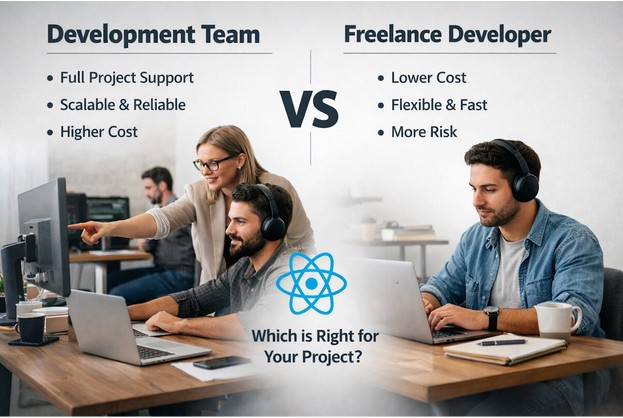
Do you work with a ReactJS development company, or do you hire a freelancer?
At first glance, the decision seems simple. Companies look structured. Freelancers look affordable. But the real answer depends on your goals, timeline, budget, and risk tolerance.
Let’s break this down clearly so you can make the right call.
Understanding What You Actually Need
Before comparing options, pause for a second.
Are you building:
- A quick MVP?
- A long-term SaaS product?
- A scalable enterprise tool?
- A short-term feature enhancement?
If your project is small, clearly defined, and unlikely to change much, your needs are different from someone building a product expected to grow over the next five years.
And React apps rarely stay small for long.
What You Get With a ReactJS Development Company
When you work with a development company, you’re not just hiring one person. You’re getting a team.
That team often includes:
- Frontend developers
- Backend developers
- UI/UX designers
- QA testers
- Project managers
You’re paying for structure. You’re paying for process. And honestly, you’re paying for predictability.
Companies that provide ReactJS Development Services in India usually follow defined workflows. There’s documentation. There’s version control discipline. There are review cycles.
If one developer gets sick or leaves, someone else steps in. Your project doesn’t stall.
That’s a big deal.
Reliability and Continuity
Freelancers can disappear. It happens. Life happens.
A company, on the other hand, has contractual obligations and backup resources. You’re less exposed to sudden downtime.
If you’re building something mission-critical, that matters.
Broader Technical Coverage
React rarely works alone. You might need:
- API development
- Cloud deployment
- DevOps setup
- Database design
- Security hardening
A company usually handles all of it under one roof. You don’t have to coordinate five different freelancers and hope they communicate well.
You deal with one team. One point of accountability.
Scalability
Let’s say your product gains traction. Users increase. Features expand. Deadlines tighten.
A freelancer may struggle to scale with you. There are only so many hours in a day.
A company can add more developers to your project when needed. That flexibility can save months of delays.
What You Get With a Freelancer
Now let’s be fair. Freelancers bring real advantages too.
First, cost.
Freelancers often charge less than agencies. There’s less overhead. Fewer layers. Less management cost.
If your budget is tight, this can be attractive.
Direct Communication
When you hire a freelancer, you speak directly to the person writing your code. No middle layers.
You can explain your idea, adjust details quickly, and move fast without formal meeting structures.
For small projects, this feels efficient.
Flexibility
Freelancers may be open to unconventional arrangements. Hourly billing. Quick fixes. Small feature updates.
If you need short bursts of work rather than a long-term partnership, this model works well.
But here’s the catch.
You’re relying heavily on one individual’s skill, availability, and discipline.
That’s a risk you need to measure.
Quality Control Differences
Companies usually have internal code reviews. Testing teams. Defined quality standards.
Freelancers? It depends.
Some are excellent. Some cut corners. Some test thoroughly. Others ship and move on.
There’s no built-in safety net unless you create one.
If you don’t have technical knowledge yourself, reviewing freelance code quality becomes harder. You may not notice structural issues until months later.
With a company, QA processes are often built into the cost.
Speed: Who Wins?
It depends on the project size.
For a small feature, a freelancer might move faster. No internal meetings. No coordination delays.
For a complex platform with multiple modules, a company usually wins. Parallel development becomes possible. Designers and backend developers can work at the same time.
Speed isn’t just about writing code. It’s about coordination.
Cost: What Are You Really Paying For?
Let’s talk numbers conceptually.
Freelancer:
- Lower upfront cost
- Lower ongoing structure cost
- Potential risk if project restarts are needed
Development Company:
- Higher upfront investment
- Structured management
- Reduced risk of rework
If a freelancer delivers clean, maintainable code, you save money.
If you later need to rebuild parts because of poor architecture, the “cheap” option becomes expensive.
So ask yourself: are you optimizing for short-term savings or long-term stability?
Communication and Time Zones
Many businesses in the US choose offshore teams.
When you explore ReactJS Development Services in India, you often gain time zone advantages. Work continues while you sleep. Progress can feel constant.
Freelancers may also operate globally, but consistency varies. Some work multiple projects simultaneously and may not respond quickly.
A company typically provides structured communication schedules. Weekly calls. Progress reports. Dedicated project managers.
That kind of predictability reduces stress.
Risk Management
Let’s talk about risk plainly.
What happens if:
- The developer quits mid-project?
- Code documentation is incomplete?
- Deadlines slip?
- Security vulnerabilities appear?
With freelancers, resolution depends on the individual.
With companies, there are usually formal contracts, SLAs, and replacement policies.
If your product handles sensitive data, structured accountability is valuable.
Long-Term Product Vision
Are you building something you plan to grow for years?
If yes, think beyond launch.
You’ll need:
- Feature updates
- Performance tuning
- Security patches
- UI improvements
- Refactoring
Many businesses eventually reach a point where they decide to Hire React Developers on a dedicated basis rather than juggling short-term freelancers.
Why? Because product development is ongoing. It doesn’t stop at version one.
A development company can assign dedicated developers who work only on your project. You get focus without losing team backup.
That’s often the middle ground.
When a Freelancer Makes Sense
Let’s make it clear. Freelancers are not a bad choice.
They’re ideal when:
- The project scope is small and defined
- Budget is limited
- Timeline is short
- You have in-house technical oversight
- The task is maintenance or feature-specific
If you know exactly what you need and can manage technical quality, a skilled freelancer can be a smart move.
When a ReactJS Development Company Is the Better Fit
A company makes more sense when:
- The project is complex
- You need backend + frontend coordination
- Security and compliance matter
- You want structured reporting
- The product will scale
- Downtime is unacceptable
In these situations, predictability outweighs short-term cost savings.
You’re investing in stability.
The Hybrid Option Most People Overlook
Here’s something interesting.
Some companies allow you to Hire React Developers as dedicated resources while still benefiting from company-level support.
That means:
- You get a focused developer
- There’s backup if needed
- QA and project oversight exist
- Infrastructure support is available
It blends freelancer flexibility with company reliability.
For many startups and growing businesses, this model hits the sweet spot.
Questions You Should Ask Yourself
Before making your decision, answer these honestly:
- How critical is this product to my business?
- What happens if development stops for two weeks?
- Do I have technical expertise in-house?
- Am I planning to scale quickly?
- Is long-term support important?
Your answers will guide you.
Not opinions. Not trends. Your actual needs.
Final Thoughts: Choose Based on Risk, Not Hype
There’s no universal winner here.
Freelancers offer agility and cost savings. Development companies offer structure and scalability.
The real difference lies in risk exposure.
If your project is a side experiment, a freelancer may work just fine.
If your project is central to your revenue, customer experience, or operations, working with an established provider of ReactJS Development Services in India or choosing to Hire React Developers through a structured company model often provides greater stability.
At the end of the day, you’re not just hiring a coder.
You’re choosing how much uncertainty you’re willing to tolerate.
So what matters more to you right now? Speed? Cost? Or long-term confidence?
Answer that, and the decision becomes much clearer.